Months have passed since you picked out the year’s curriculum and set out on the year’s journey of homeschool. You made goals and plans and set out with bright thoughts on all your kids will learn and do this school year.
But is it all still working? Are your kids getting what they need? Are your plans all awash now in the middle of the year? Let’s dig in to all those insecurities with a mid-year review of your homeschool!
This is a quick look at your homeschool, not a full planning overhaul. If you ever want help with the deeper reset or big-picture vision work, I’ll share more resources at the end of the post.

What is a mid-year review?
You can think of a mid-year review of your homeschool like an evaluation you may get at a traditional job. After several months on the job, your supervisor comes to be sure you are accomplishing all that you are supposed to be doing. They check on your work and see if you are meeting goals and check on your attitude about it all along the way.
That is what you can do with your homeschool in a mid-year review. Look at all your homeschool plans for year to see if you are meeting goals and objectives and if there are new developments or changes that need to be made.
It’s a check-up on the state of things in your homeschool. Sometimes the check-up is completed quickly and easily and sometimes it unearths some problems that need to be looked at further.
Why should I review my homeschool?
Occasional reviews of our homeschools should be done to ensure that the needs of our children are still being met. It’s always good to evaluate and see if you as the teacher think things are going well. This is the time to look into your day to day stresses and see if there are ways to improve.
One of my favorite college professors said all the time, “When it stops getting better, it stops being good.” The idea is that things grow stagnant when we just live our lives on autopilot. We must tend to things and always improve upon them.
If you take dedicated time to look at your homeschool, it can help you gain the focus and perseverance you need to keep going. It can help you reset mentally and work through any challenges you may not even realize you are facing.
If you are not setting dedicated time aside to plan and review the homeschooling of your children, then I’d venture to say you aren’t taking it seriously enough.”
When is a good time to evaluate my homeschool year?
There really is never a bad time to evaluate your homeschool year. It is great to briefly look over things in your homeschool every month or two throughout the school year.
Then once in the middle of the school year, do a larger mid-year review. At this point you can look over all your plans from beginning to end.
If your plans have been set up well, much of the year can go by without a hitch. And it is good to allow this to happen and continue life smoothly without analyzing every step you make in your homeschool.
You may troubleshoot problems that arise throughout the year, and focus in on those. But a big look at your entire homeschool is often not done for months.
In our homeschool, we officially start our new school year in July, so I like to evaluate our plans in early January or late December. I often take a couple weeks off school around Christmas time, so this is a good time for me to work in a mid-year review and planning time for our homeschool.
Some families love to do a simple mid-year check-in, others prefer a deeper reset. This post will help you get it done in a simple way.

How to do a mid-year review
A mid-year review of your homeschool can be done in many ways and can cover many areas. Here are 11 things I think are important to cover in a mid-year evaluation of your homeschool.
1. Set time aside
To be successful at something, we need to dedicate time to it. If you are not setting dedicated time aside to plan and review the homeschooling of your children, then I’d venture to say you aren’t taking it seriously enough.
A mid-year review doesn’t have to take a huge chunk of time. But it does need your full attention. Start with setting aside a couple hours in your day and go from there. If you end up needing more time do all you have intended, find a few more hours at another time.
2. Do a brain dump
If you want to focus on something and do it well, one of the first things that’s helpful to do is a brain dump. Moms carry tons of stuff in our heads. Get it all out. Type it, write it, tell it to your mirror. Just get it out until you can think more clearly.
A simple brain dump can help clear the mental clutter. Grab a piece of paper and jot down anything on your mind – homeschool, home routines, struggles, goals, questions, ideas. This doesn’t need to be neat or organized. It just helps you see what’s there.
You may also find you want to dive further into a certain topic. Here’s an easy way to help you brainstorm. Go ahead. It’s worth it.
3. Evaluate
Evaluating your homeschool mid-year is a valuable way to check on your efforts. You are able to look at every area and see how things are going. Think about the things you have done, and compare all that to your original plans.
Choose a few key areas of your homeschool and simply jot down what’s working and what feels heavy or off. You don’t need to evaluate every single subject or child right now. This is just a snapshot.
4. Review your goals
Remember all those big goals and plans you had for your school year? Have you looked at them recently? Pull those out now and take a look. Are you still on track?
Goals help us to remember what is important in our homeschool – if they’re done well of course.
Reviewing these goals may help you reset all the stresses you’ve put on yourself as a homeschool mom. They may take you back to the basics that are important to you.
But if your goals stress you out, then this is a good chance to rework them. Or maybe you should just start over from scratch!
Remember that this homeschooling thing is a marathon, not a sprint. You can’t do all the things every year.
And to really mess up that metaphor, I’ll add that it’s not a race at all. We’re not competing to produce the smartest kid. If that’s your goal, you should think long and hard about that. I think your ultimate goal should be to help your kids enjoy learning. Simple as that.
5. Update attendance
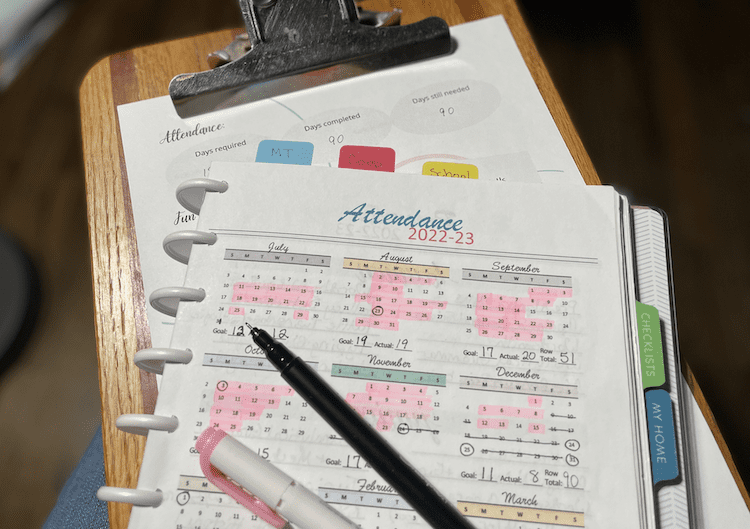
During a mid-year review is a good time to update your attendance records.
I recommend you keep track of this throughout the year. Some states require it and others don’t. But I find keeping records of the days you do school is helpful whether it’s required by law or not.
Keeping attendance is helpful for:
- planning out your school year and what you want to cover.
- making sure you are getting in a good amount of time learning throughout the year.
- backing you up legally if your homeschool efforts were ever challenged.
We start our homeschool each year in July so by the time I’m doing a review around the new year, we’ve usually gotten in around 90 days or so. My state requires 180 days a year, so that’s half way to my yearly goal – right on track.
I’ll be honest that sometimes it’s less than 90 and that’s ok. It seems like the fall semester is broken up with so many breaks and holidays it can be hard to get all our days. But I find during Winter I can often catch up on a lot of good school days. It works out in the end.
For more info on attendance records, like what to keep and how, check out my post on attendance records. You’ll find everything you need to know on tracking days and hours as well as ideas for schedules! Plus free trackers!
6. Add in fun stuff for kids
Sometimes we can get so caught up in the work of school, that we forget to have fun. I mean, truthfully, there is always soooo much to do, isn’t there?
But I don’t want my kids to grown up and remember me as a grumpy schoolmaster mom. I want to be a mom that helped them learn but also loved to be with them. So I try to remember to add in fun things to do together here and there in our homeschool life.
If fun isn’t easily on your radar, it’s ok to schedule it in. Plan in some fun stuff for your kids.
- Join a relaxed coop with fun classes
- Go on lots of field trips
- Go to a fun homeschool time at your local library
- Go skating
- Go bowling
- Play a board game
- Go on a hike with no agenda. (Don’t always kill the fun with a lesson!)
- Read a book together just because it’s a good book.
- And be there with your kids. Truly be there.
We are homeschoolers for a reason, and many do this so they can set their own schedule. So schedule in the fun stuff too.
Sarah Mackenzie from Read Aloud Revival does fun days like this and calls them “Just Because We Can” days. She schedules them in and has a good time with her kids. Your kids need more of this with you.
7. Reassess commitments
Are you constantly running around from place to place? Always stressed? Or maybe you have nothing going on and want to add in a thing or two to your schedule. Now’s a great time to look over all your commitments in your normal week and see if you need to make changes.
It’s ok to back off and let some things go. Remember your goals for the year. If some of your commitments don’t line up, let them go.
It’s important for your children to have unscheduled free time in their schedules. This allows time for pursuing interests and creativity. It also will reduce stress on all involved.
Maybe you’ve been wanting to look into a new activity but haven’t made the time. During your mid-year planning time is a great opportunity to do the research and make the calls to add things to your schedule.
Want to put these tips in motion today? Download your FREE Homeschool Restart Planning Pack through this link!
8. Check up on the schedule
It’s always a good idea to look over your schedule and see how things are working for you.
If your mornings are starting later and later each day, perhaps you need to buckle down again for a good start to your day. Or maybe you are being too strict, and could loosen things up a bit in your days.
For more ideas on scheduling and attendance, check out my post on keeping attendance records.
9. Catch up on planning and grading
When life gets crazy, it’s easy to put off the tedious things. If you’re anything like me, you may have a difficult time staying up on planning and record keeping in your homeschool. This mid-year review time is a great opportunity to catch up on all those things.
Use this mid-year moment to catch up on whatever small administrative tasks have piled up, whether that’s refreshing lesson plans, updating records, or looking ahead at your next unit.
For some help organizing your homeschool and planning out your year, download my free homeschool planning pages by clicking this link!
Don’t even know where to start with homeschool planning? Check out my post about planning your homeschool year!
10. Gather and input records
Once you’re all caught up on the paperwork, you can actually gather and input those grades and attendance records! Some states in the US require that you submit grades and attendance mid-year. Whether this is required of you or not, it can be a great habit to practice.
Keeping grades for each semester can help many students stay motivated. It also may help you stay accountable to yourself by ensuring completion of school work. Grades are also an easy way to show others how and what your kids are doing in your homeschool.
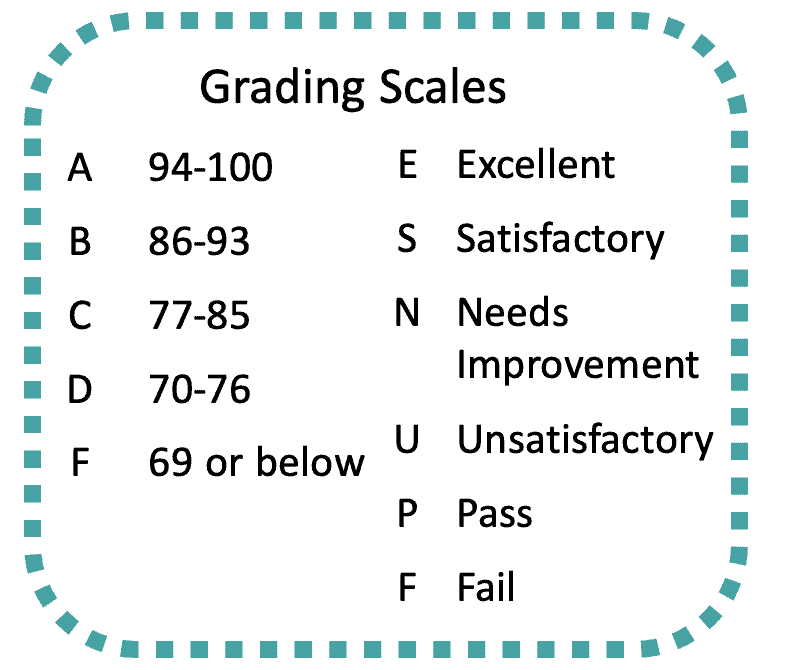
Don’t get bogged down by this, especially for young children. “Satisfactory” and “excellent” are prefect for elementary students. You’re the teacher. Just give them a grade.
Here are some sample grading scales:
If you have to report semester grades and/or attendance records to your state or umbrella school, this is your reminder to get that done!
11. Make any changes needed
Once you’ve reviewed things, make note of any changes you want to make going forward. That may be adjusting a book list, shifting a routine, or simplifying expectations.
You don’t need to figure out every detail right now. Just capture the things you want to remember to come back to.
Free worksheets download
Free Homeschool Restart Planning Pack
- A simple structure that works with any homeschool style.
- A Homeschool restart checklist to help you restart with clarity.
- A one-page evaluation and planning sheet to map out your return.
- A calm, clutter-free starting point so you’re not scrambling on day one.
- A first-week-back planner page to calmly ease into lessons.
- A lighter first week that sets your whole month up for success.
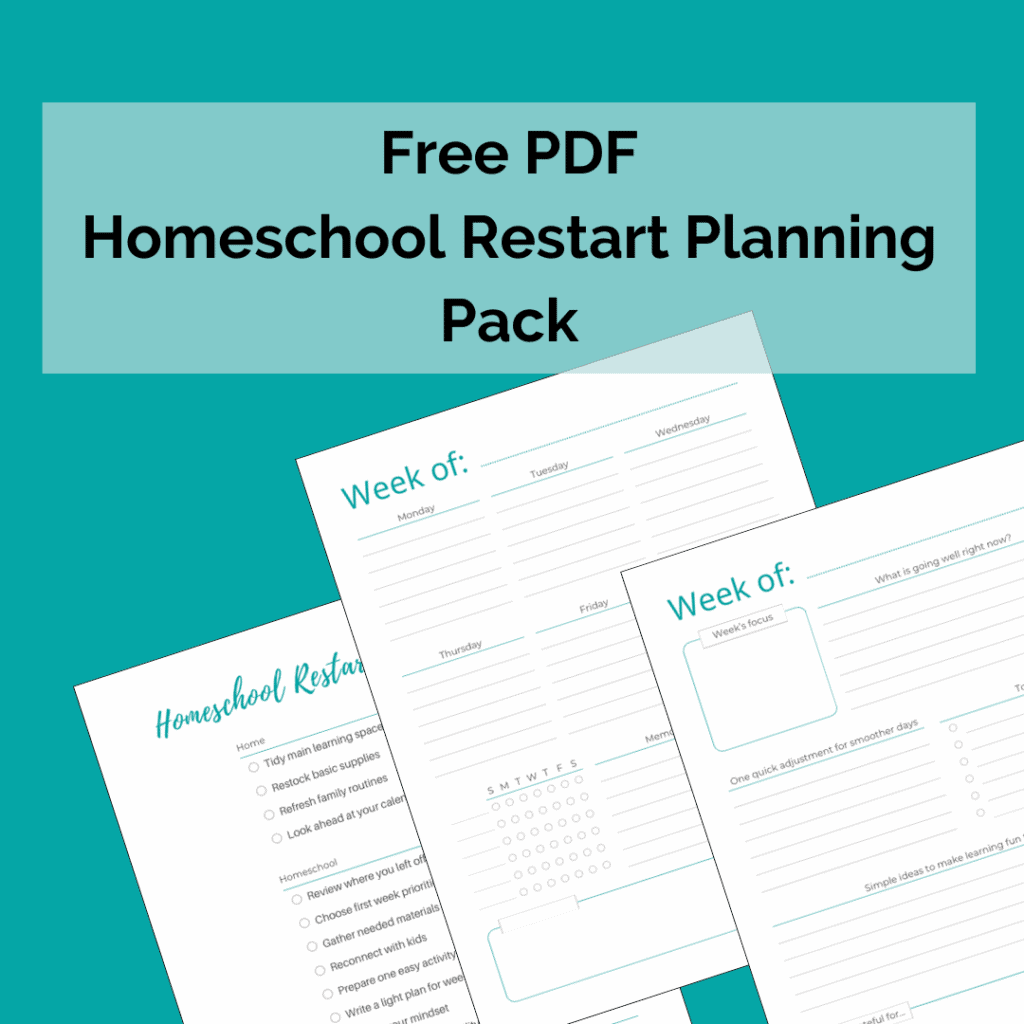
This Homeschool Restart Pack offers a simple, no-stress framework to help you reset, refocus, and ease confidently into your first week back.
Tips for success
Here are a few quick tips to help make a mid-year review of your homeschool successful.
Have a plan
Having a simple plan before you start will make your time much more productive. Decide where you’ll work, how long you have, and what you want to think through. A quiet space and a clear mind go a long way.
Make it fun
Planning doesn’t have to be drudgery. Try to make it fun. Get yourself a treat while you’re out or make a little time for something you love. Getting together with a friend or two can also help you look forward to your planning and review time.
Check out my post on making your planning time less terrible for more ideas!
Don’t be in a rush
Give yourself enough breathing room to think clearly. This doesn’t have to be rushed. A bit of unhurried space can make the whole process feel calmer and more grounded.
Closing
Homeschooling your children is a big job and requires a good bit of thought and planning. Once you start your year and getting going, it’s not always smooth sailing.
A mid-year review of your homeschool is a fabulous way to look over all the parts of your homeschool life and see how things are going. Set yourself up for success in the months to come and evaluate your homeschool mid-year!
Related posts
How to make your homeschool planning time less terrible
23 Paper Homeschool Planners You’ll Love
The Best Online Homeschool Planners